The Art of Letting Go: Teaching Pen Through Surrealism
One of my favorite things about teaching art is watching what happens when students have the skills to succeed and the freedom to take those skills somewhere unexpected.
I believe in scaffolding, especially in a drawing class where students often arrive believing they are either “good at drawing” or they aren't. Building confidence through small successes helps students feel prepared to take creative risks. But I also believe in knowing when to step back and let students find their own way.
My pen unit in my Drawing & Painting course is a great example of this balance.
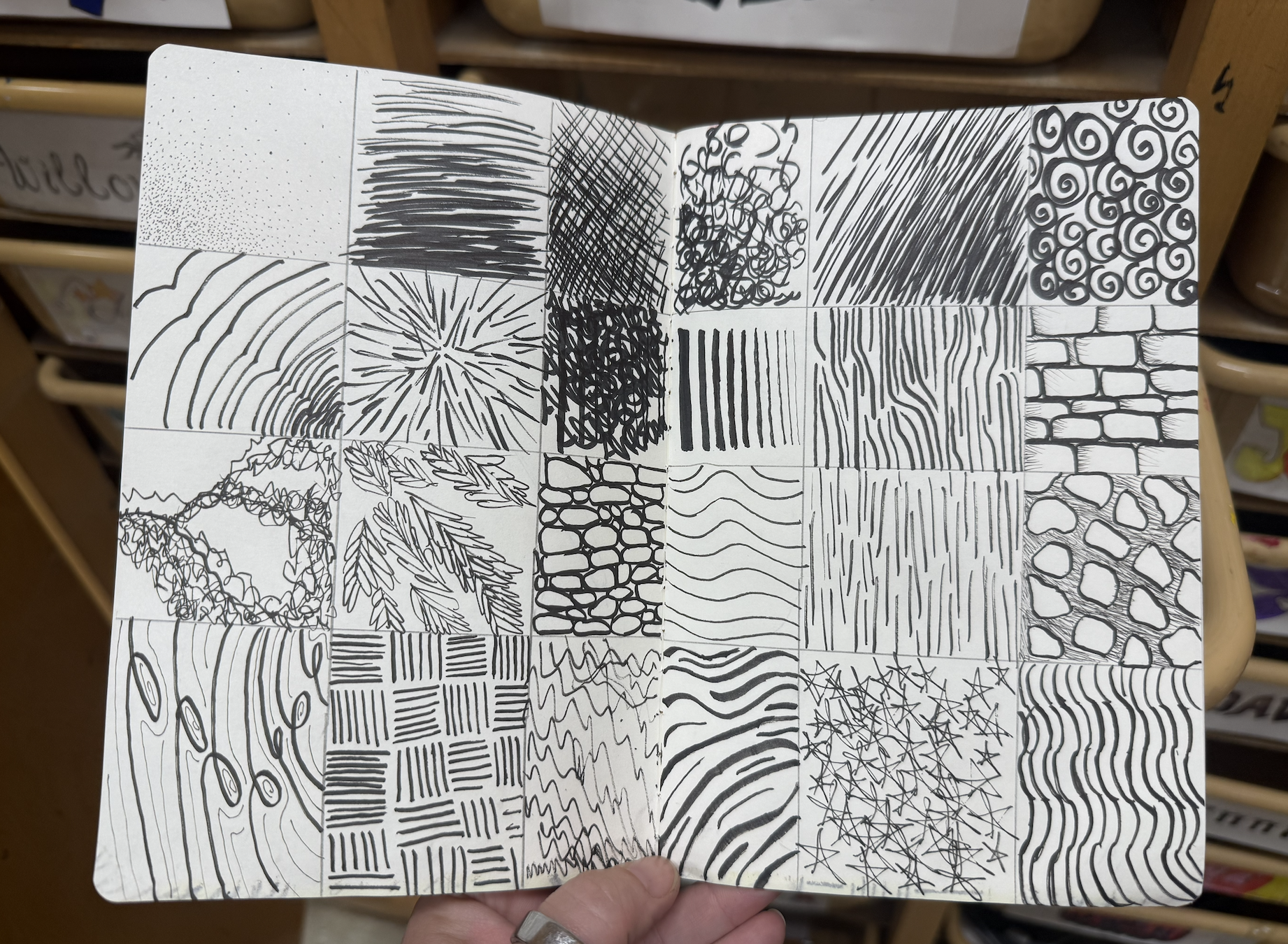
Student’s Mark Making Grid
Start with the Basics
We begin with a mark-making grid where students experiment with different pen textures and techniques. Then, we practice building value with hatching, cross-hatching, stippling, and scumbling.
These exercises give students a visual vocabulary to draw from. They learn how simple marks can create texture, depth, and dimension while building confidence with the medium.
Next, we introduce Inktober! Since I LOVE ink, this is an exciting time of year for me. Inktober is a worldwide art challenge where participants create an ink drawing every day throughout the month of October. Since I like to display these projects in October, we begin this in September. Students randomly select three prompts to illustrate, and I share examples from artists on Instagram (from last year’s challenge) to show how differently one prompt can be interpreted. The goal isn't to copy these artists, but to see the possibilities! One word can inspire endless ideas, and there is no single correct answer. This is why I love Inktober as a way to bridge the skills to their own ideas.
These early activities provide structure while gradually giving students more ownership of their creative decisions.
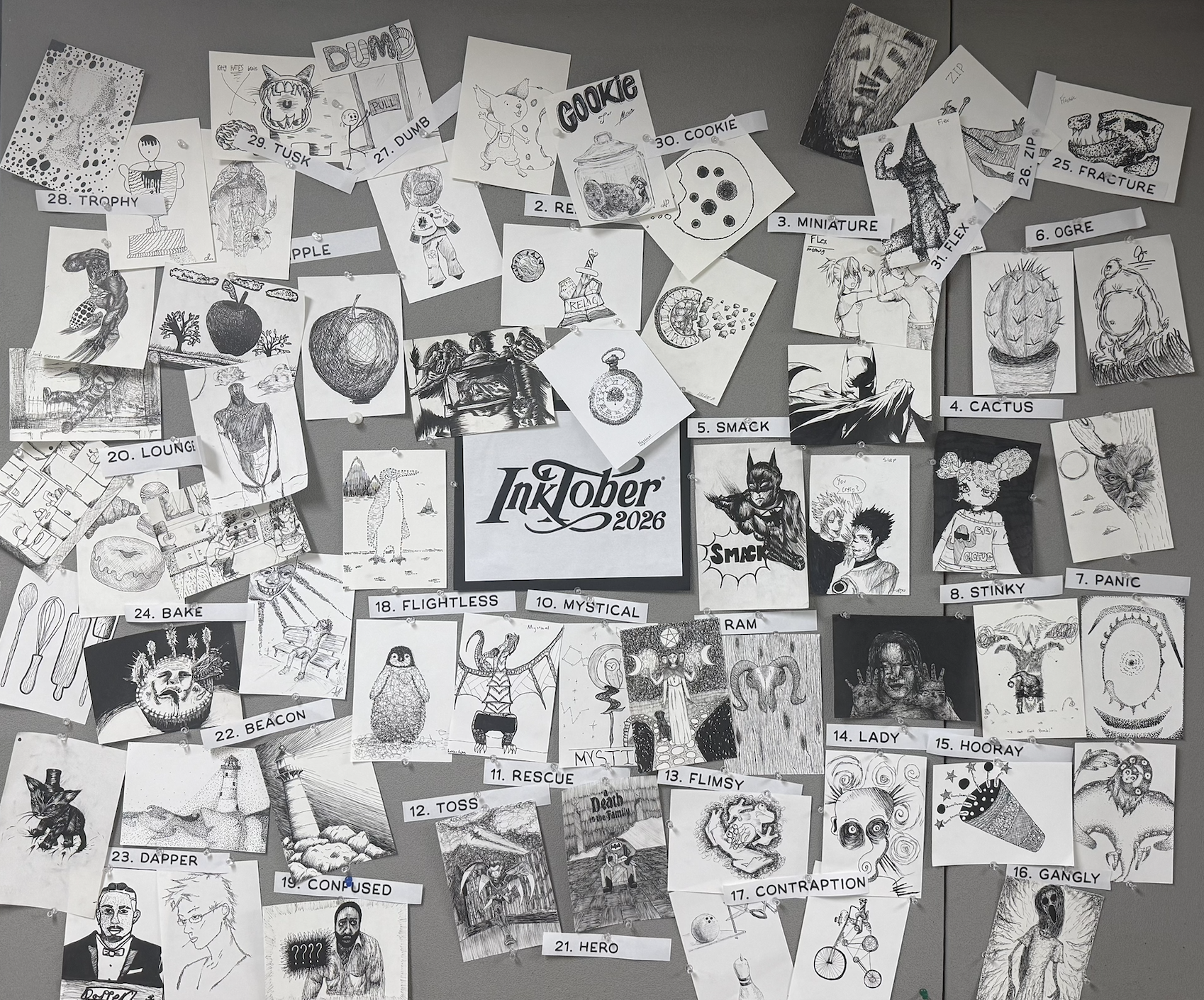
Inktober Hallway Display
Making Space to Breathe
Throughout this course, I love moving between realistic observational drawing and more exploratory, abstract, expressive modes of drawing. After spending time developing technical drawing skills, I want students to have space to experiment, loosen up, and listen to their own creative voices.
This is where I introduce Surrealism. We look at surreal artists and explore the games abd processes that led to the artwork of unexpected imagery and allowing marks to lead ideas and develop without controlling every decision.
What are some Surrealist games we play?
Exquisite Corpse: The exquisite corpse is a collaborative parlor game adopted by the Surrealists in Paris around 1925 to bypass conscious control and tap into the unconscious mind. Participants take turns writing words or drawing sections of a figure (such as a head, torso, legs, and feet) on a sheet of paper (without seeing what the previous artist put on that same paper). A nice way to incorporate CHANCE into your artwork.
Automatism: Automatism in surrealism is a creative technique that bypasses conscious thought and reason to let the unconscious mind dictate writing, drawing, or painting. Make a mark, let that lead you into the next image, the next mark, without planning the final image.
I encourage students to be curious rather than critical too early. What if they follow an unexpected mark instead of erasing it? What if one shape leads to another? Not every drawing needs a reference image or a predetermined outcome. Sometimes students need permission to explore without knowing exactly where they are going.
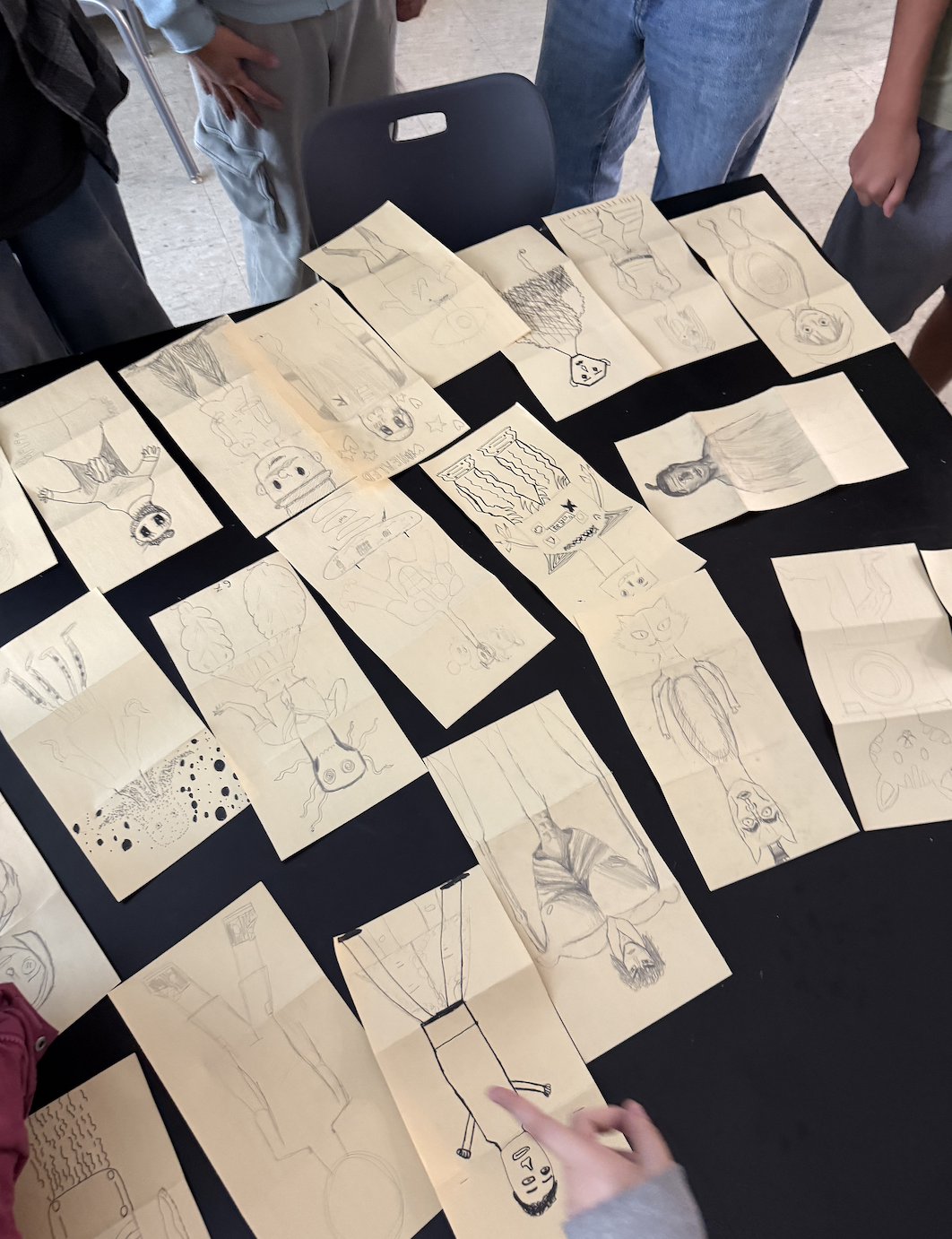
Surrealism Games to Inspire Imagery
Make something extraordinary with your pen.
For the main project, I give students a white square paper and a pen. After all our practice and exploration, the directions are simple:
Make something extraordinary with your pen.
There is no required subject or step-by-step drawing to follow. Students can begin with an idea, a random mark, or an unexpected combination of images. The goal is to explore the medium and create something thoughtful, imaginative, and uniquely theirs.
The assignment is open-ended, but it isn't unsupported. Students already have techniques to draw from, artist examples to inspire them, and experience experimenting with ideas. They have a foundation. Now they get to decide what to do with it.
Once their drawings are complete, we extend the project onto a larger piece of black paper. Students use their white pens to continue their imagery beyond the original square, considering how shapes, patterns, and ideas might grow into the surrounding space.
It's a simple way to challenge students to look at their work differently and discover what happens when an idea continues beyond its original boundaries.
Let Your Students Surprise You
I've taught this unit for years, and the students continue to amaze me. The finished work is so varied, from intricate, detailed worlds to strange combinations of objects, abstract forms, and dreamlike imagery.
That variety is exactly what I hope for.
Scaffolding helps students feel capable, but creative freedom allows them to discover what they can do on their own. Success doesn't have to look the same for everyone. Sometimes it's mastering a technique; other times, it's taking a risk or developing an idea they wouldn't have attempted before.
I don't believe every art assignment needs to be completely open-ended. Students need demonstrations, practice, and clear expectations. But we also need to recognize when it's time to step back.
The goal isn't simply to teach students how to draw with pen. It's to help them trust their instincts, experiment with uncertainty, and discover what their own ideas can become.
We can provide the tools, build the foundation, and create the conditions for success.
And then we can hand them a pen and let them surprise us.
